
HER Healthspan Method · Functional Health + Nutrition for Women
Perimenopause and Menopause Nutrition
By Dr. BB Beba, DCN, CNS · Last reviewed: October 2026
Perimenopause and menopause nutrition is food, sleep and stress support built for the years when your hormones are shifting. At NutritiousDr, functional nutritionist Dr. BB Beba, DCN, CNS, listens to your full story, reads your bloodwork against optimal ranges and builds a plan with you. Available to women in New Jersey and Connecticut, online by secure video.
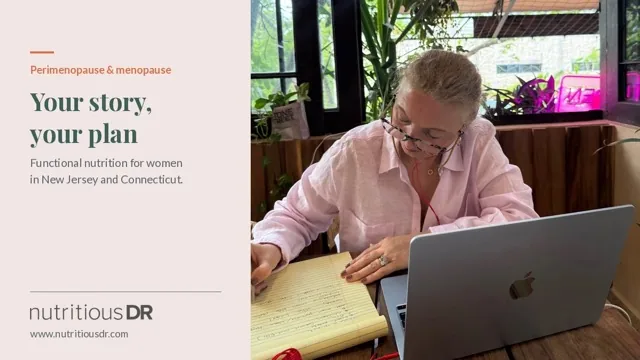
If the weight, the broken sleep and the mood swings have you feeling like a stranger in your own body, you're not imagining it. Perimenopause quietly rewrites the rules. With nutrition built for this stage of life, you can work with the changes instead of fighting them, and start to feel steady again.
What is the difference between perimenopause and menopause?
Perimenopause is the transition: the years leading up to your final period. It often begins in the 40s, sometimes earlier, and can last several years. During this time estrogen and progesterone don't simply fade. They tend to swing up and down before they settle lower, which is why this stage can feel like such a moving target.
Menopause itself is a single point in time. You reach it once you have gone 12 full months without a period. The Menopause Society puts the average age of menopause in the US at about 51. Everything after that point is called postmenopause.
Not sure which stage you are in? That's a very common place to start, and it's exactly the kind of question we can talk through together.
What are the common signs of perimenopause?
Every woman's experience is different, but these are the changes we hear about most often:
- Sleep that broke for no obvious reason, often waking in the early hours.
- Cycles that change: periods that come closer together, further apart, heavier or lighter.
- Weight settling around your middle, even though you haven't changed how you eat.
- Mood shifts: new irritability, anxiety or a shorter fuse.
- Low energy and brain fog, including words that slip away mid-sentence.
- Hot flashes or night sweats.
If a few of these sound familiar, you're in good company, and you don't have to figure it out alone. Some signs are far less talked about. We cover them in Perimenopause Symptoms Nobody Warned You About.
Why did the habits that used to work stop working?
This isn't a willpower problem. The way of eating and moving that carried you through your 30s can stop working the same way in your 40s. That's biology, not failure.
For many women, the shift in estrogen changes where the body tends to store fat, with more of it settling around the middle. It can also make the body less sensitive to insulin.
Muscle mass also declines with age, and muscle is a big part of how your body uses energy. Add broken sleep and a stress system that is already running warm, and cravings, energy dips and perimenopause weight gain start to make a lot more sense.
The old reflex is to eat less and exercise harder. At this stage that often backfires. Your body tends to respond to support far better than to punishment. Read more about what changes in Metabolism and Weight After 40.
How does NutritiousDr work with women in perimenopause and menopause?
Dr. BB's approach starts from one belief: "I believe your labs tell a story, but your symptoms tell the truth." Here's how working together usually unfolds.
- A free 15-minute call. You share what you're experiencing, and we tell you honestly whether our approach is a good fit.
- Listening to your full story. Sleep, cycle, digestion, stress, energy, what you eat and what you have already tried. Your symptoms are data.
- Reading the bloodwork you already have. Many women bring results that were called "fine". We look at them against optimal ranges, because normal is not the same as optimal. (More on that in why normal bloodwork doesn't always mean you feel well.)
- Testing only when it adds clarity. An advanced hormone panel, a comprehensive stool analysis or detailed bloodwork can sometimes fill in the picture. It is never a requirement. See Lab Testing.
- A plan for food, sleep, stress and your nervous system. Built around your life, your preferences and this stage of it, then adjusted as you go.
Two practitioners, one plan
Dr. BB Beba, DCN, CNS is a Doctor of Clinical Nutrition and Certified Nutrition Specialist. She leads the clinical side: your history, your labs and your nutrition plan.
Nesko Elden is a Health Transformation Coach, Certified Integrative Nutrition Coach and breathwork practitioner. He brings coaching, body-based practices and breathwork alongside Dr. BB's plan, so the changes are easier to live with day to day.
The HER Healthspan Method
Our work follows the HER Healthspan Method, founded by Dr. BB and Nesko: H for Hormones, E for Energy and R for Resilience. It looks at all three together, rather than chasing one symptom at a time.
The HER Metabolic Reset: a group option
If you would like to start in a small group, the HER Metabolic Reset is a 4-week guided program led by Dr. BB and Nesko. It includes:
- live group sessions;
- meal guidance with menus and shopping lists;
- a private evaluation with Dr. BB;
- app-based food journaling.
Wondering if this is perimenopause? Let's talk it through. No pressure, just answers.
Book a free 15-minute call Or call (701) 369-0890Who is perimenopause and menopause nutrition for?
This work is for women in their 40s and 50s who:
- feel that something has changed, and have been told they're "fine";
- are gaining weight around the middle without changing how they eat;
- are tired of waking at 3 a.m. and running on empty;
- have bloodwork that looks normal on paper but don't feel well in their body;
- want a plan that works alongside (never in place of) their medical care.
Where do you see clients?
NutritiousDr is based in Branchburg, in Somerset County, New Jersey. We work with women across New Jersey and Connecticut, online by secure video.
Frequently asked questions
Can a nutritionist help with perimenopause?
Yes. For many women, nutrition is one of the most useful kinds of support during perimenopause. Food, sleep and stress habits can help steady energy, blood sugar and mood while your hormones shift. Our work sits alongside (never in place of) your medical care.
Do I need hormone testing?
Not always. Sometimes an advanced hormone panel adds real clarity, but it is never a requirement. We start with your story and any bloodwork you already have, and only suggest testing when it would genuinely help.
Is this instead of hormone therapy?
No. Whether hormone therapy is right for you is a conversation with your doctor. Our work sits alongside it, whatever you and your doctor decide.
Can nutrition help with perimenopause weight gain?
It can help many women. Eating to protect muscle and steady blood sugar, sleeping better and easing stress often matter more than eating less. Individual results vary, and we never promise a number on the scale.
Do you work with women outside New Jersey?
Yes. We also work with women in Connecticut, online by secure video.
What happens on the free call?
It's a relaxed 15 minutes. You share what you're experiencing, we tell you honestly whether our approach is a good fit, and you leave with a clearer sense of your next step, with no pressure either way.